

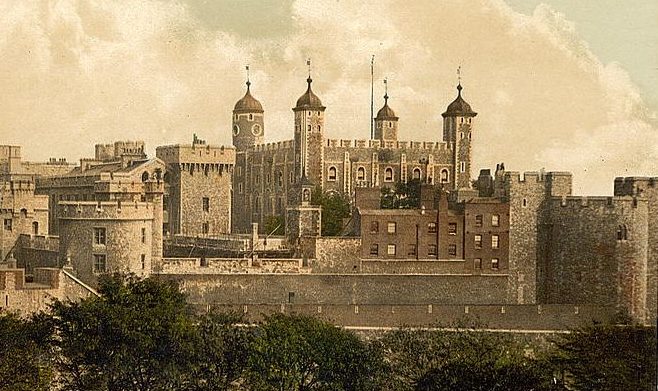
In the shadow of impenetrable stone walls and its fearful reputation of torture and imprisonment, life inside the Tower of London was far from ordinary. But for one remarkable woman in the 17th century, the Tower wasn’t just a fortress—it was home, hospital, laboratory, and sanctuary. My novel The Lady of the Tower brings to life the incredible story of Lady Lucy Apsley, who lived, worked, and raised a family within these forbidding walls for thirteen years. Not just the wife of the Lieutenant of the Tower, she was a healer, a caretaker of both body and soul, and a patron of knowledge. Visiting her home and the site of her gardens, I could easily imagine the life she led.
A Healer in the Heart of Power
The Tower of London was infamous for its grim reputation as a prison, yet within those high walls, life continued. Lady Apsley served as an unofficial medical practitioner for prisoners and residents alike. At a time when the line between science and superstition was thin, she combined her deep understanding of herbal medicine with compassion for her patients “treating them all with a mother’s kindness” according to her daughter, memoirist Lucy Hutchinson. Her patients included not just those held captive, but the guards and servants who made the Tower their home.
Lady Apsley wasn’t merely tending illnesses; she was mending spirits. The fear and isolation within the Tower’s walls made any act of kindness an extraordinary balm. With knowledge passed down through generations of women, and recipes exchanged between friends and neighbours, she prepared tinctures, poultices, and teas to treat fevers, infections, and melancholy.

Sir Walter Raleigh’s Alchemical Dream
One of the Tower’s most famous prisoners during this period was Sir Walter Raleigh. Imprisoned for treason, Raleigh spent much of his time experimenting with alchemy – in Lady Apsley’s henhouse. The “Lady of the Tower” was intrigued by Raleigh’s work and encouraged his pursuit of the philosopher’s stone—not just as a quest for gold, but as a way to unlock deeper medical truths. The blending of alchemical experimentation with practical healing was a reflection of the Renaissance spirit of inquiry, where boundaries between disciplines blurred, and new knowledge emerged from unlikely sources.
This collaboration between Lady Apsley and Sir Walter symbolised a unique alliance. They understood that true power lay not in gold but in knowledge and healing. Their shared intellectual curiosity represents a forgotten chapter in the Tower’s history—one where learning persisted even in confinement.

The Medicinal Garden: Nature’s Fortress
Perhaps the most enduring symbol of Lady Apsley’s resilience and wisdom was her medicinal garden. Tucked within the Tower grounds, this patch of earth was her refuge and laboratory. In an era when apothecaries could be expensive and out of reach, growing one’s remedies was essential. Her garden was filled with herbs like lavender for calm, rosemary for memory, and feverfew for pain.
At a time when the line between science and superstition was thin, she combined her deep understanding of herbal medicine with compassion for her patients “treating them all with a mother’s kindness” according to her daughter, memoirist Lucy Hutchinson. Her patients included not just those held captive, but the guards and servants who made the Tower their home.
Lady Apsley wasn’t merely tending illnesses; she was mending spirits. The fear and isolation within the Tower’s walls made any act of kindness an extraordinary balm. With knowledge passed down through generations of women, and recipes exchanged between friends and neighbours, she prepared tinctures, poultices, and teas to treat fevers, infections, and melancholy.
Each plant had a purpose. Beyond their medical uses, the garden’s existence was a quiet refuge of hope. Amid cold stone and iron gates, life grew. The Lady of the Tower’s garden was not just about survival—it was about thriving in the face of adversity.

Raising Children in a Fortress
Living in the Tower wasn’t just a duty; it was a family affair. For 13 years, Lady Apsley raised her children within its walls. Imagine the challenge of nurturing innocence in a place synonymous with imprisonment. Her role as a mother added another layer to her strength. She provided her children not just with a safe environment but with stories of resilience, a broad education , and lessons in compassion. Consequently, her children grew up with an intimate understanding of the Tower’s complexities. It was a place of both darkness and light, cruelty and kindness.
A Legacy Remembered
The Lady of the Tower isn’t just a story of one woman’s quiet strength. It’s a tribute to the many unsung heroines who practiced healing arts, nurtured families, and fostered intellectual growth in the most unlikely places. Her garden, her medical practice, and her support of scientific inquiry are threads in the larger tapestry of women’s history—one often overshadowed by the tales of kings and statecraft.
Today, as we walk through the Tower grounds, we might imagine the faint scent of lavender or the murmur of forgotten knowledge. Lady Apsley’s story reminds us that even in the most constrained circumstances, growth and healing are possible.
 In The Lady of the Tower, Lady Lucy Apsley turns the formidable Tower of London into a haven of resilience and healing. For 13 years, she navigates life within its stone walls, tending to prisoners and guards with remedies from her medicinal garden. While raising her children in this harsh environment, she defies expectations, blending compassion with strength. Lady Apsley’s story reveals the hidden lives of women who shaped history, nurturing hope where others saw only confinement.
Based on the true story of my ancestor, Lucy St.John Apsley, this critically acclaimed novel offers a vivid portrayal of one woman’s resilience in the face of betrayal, and her courageous journey through the turbulent politics of seventeenth-century England.
Available on Amazon and Kindle Unlimited
Now On Sale for 99p / 99c









Dear Elizabeth St John, thank you for writing such enthralling novels on the lives of the families of Sir Allen Apsley and Lady Lucy St John. These two noble people are my direct ancestors of 12 generations. I have purchased the Lydiard Chronicles and have finished reading the Lady of the Tower, which I loved, and now I am on to reading the other two books. Your writings of the journeys of my ancestors are so accurate, enlightening and enthralling. Thank you for writing and publishing these stories for all to read and to respect the lives they lived 500 years ago.
Hi Carla
How lovely to hear from you, and what a privilege to hear that you are Lucy and Allen’s direct descendant. Thank you for your very kind words about my novels, and it makes it even more special, knowing that you’re “family”! Have you had a chance to explore The Lydiard Archives? There’s a lot of great information about the family and Lydiard Park, St. Mary’s Church and the parish – enough family history to keep you going for an age! The website is http://www.thelydiardarchives.org.uk – it’s run by the Friends of Lydiard Park. Thanks again for stopping by, and do let me know what you think of the rest of the Chronicles! With all good wishes, Elizabeth