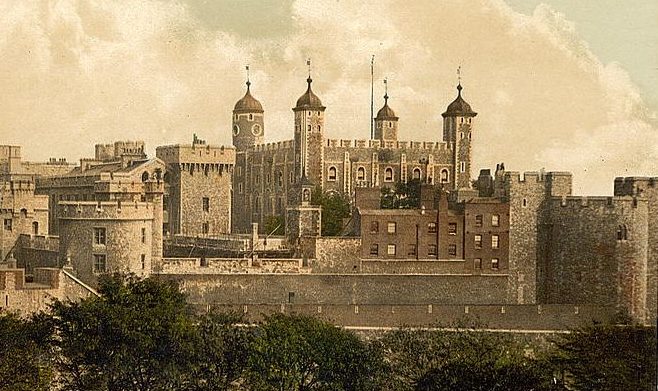
In the spring of 1483, a twelve-year-old boy became king of England—but never wore the crown. Edward V, eldest son of Edward IV, inherited the throne upon his father’s sudden death. Yet before his coronation could take place, in June 1483 his uncle Richard, Duke of Gloucester, assumed the role of Lord Protector and quickly moved to consolidate power. What followed was one of the most tragic and hotly debated episodes in English history: the deposition of a child king, the rise of Richard III, and the unexplained disappearance of Edward and his younger brother, Richard, Duke of York.
This historical mystery lies at the heart of my novel The Godmother’s Secret, in which I reimagine these events not through the lens of court propaganda or later Tudor mythmaking, but through the eyes of someone who lived them—and who carried a dangerous secret. That someone is my ancestress, Lady Elysabeth Scrope.

Elysabeth was no marginal figure. She was at Edward’s birth in sanctuary, attending Elizabeth Woodville, queen to Edward IV, and served as godmother to the young King Edward V. But beyond those roles, she had another, even more personal connection to this fraught moment in history: her daughter, Margaret, married William Catesby—making Elysabeth Catesby’s mother-in-law. In The Godmother’s Secret, she stands at the crossroads of loyalty and conscience, caught between the son-in-law who served Richard III and the godson who vanished.
William Catesby has often been maligned by history, painted as a ruthless schemer and one of Richard III’s “cat’s paws.” In July 1484, a year into Richard III’s short reign, William Collingbourne posted a lampoon on the door of St Paul’s Cathedral. It read: ‘The Cat, the Rat and Lovell our dog, Rule all England under a Hog’ and referred to Catesby, Richard Ratcliffe and Francis Lovell, Richard’s trusted lieutenants. But the truth is more nuanced. Will Catesby was a brilliant legal mind, respected for his intellect and trusted by both Edward IV and Richard. His rise was based on his skill and judgment, not merely ambition. And yet, he stood at the centre of one of the most consequential—and controversial—legal decisions of the age: the disinheritance of Edward V.

Catesby’s family was closely linked to the claim that ultimately brought Edward’s brief reign to an end: the alleged pre-contract of marriage between Edward IV and Lady Eleanor Talbot, for they represented the Talbot family in many legal matters. Catesby’s contemporary, Bishop Robert Stillington, claimed to have witnessed the pre-contract, making Edward’s later marriage to Elizabeth Woodville invalid and their children illegitimate. It was this revelation that Parliament used to justify Richard III’s accession to the throne via the Titulus Regius.

Once declared illegitimate, Edward V and his younger brother were moved from the Royal Palace within the Tower of London to a deeper, more secure lodging (possibly the Bloody Tower or the Lanthorn Tower) “for their safety.” And then—they vanished. No public search. No formal record. No public funeral. Just silence.
In The Godmother’s Secret, I step into the void. I ask: what if Elysabeth Scrope, godmother to the deposed king and mother-in-law to one of the men who helped bring about his fall, was entrusted with a secret too dangerous to speak? What if she was given the chance to act—not as a pawn of politics, but as a woman of courage? What if she and her daughter Meg, Catesby’s wife, knew exactly what happened?
To make matters even more fraught, Elysabeth was Margaret Beaufort’s half-sister. Henry VII was her nephew. What an extraordinary eyewitness to history she was.
Catesby’s role in these events did not end with Richard’s reign. After Richard III was defeated at the Battle of Bosworth in 1485, Catesby was captured and executed by the new king, Henry VII. But even in death, his legacy remains controversial. His tomb in his family church in Ashby St. Ledger, Northamptonshire, bears a striking feature: a deep gouge across the engraving’s neck, a visible reminder of his execution—and perhaps of the weight of the decisions that haunted him.
As a historian and author, I write fiction grounded in fact. I follow the threads of evidence, but I’m also guided by intuition and imagination, especially where history leaves only silence. In the disappearance of Edward V, there is no definitive answer—but many plausible truths. My own family’s proximity to these events gave me a unique perspective and an emotional lens through which to tell this story.
What if someone did know the truth?
What if they risked everything to protect it?
And what if, through family connections and political manoeuvring, an uncrowned king lived?
The Godmother’s Secret is available in paperback, Kindle, Kindle Unlimited and audiobook (read by me).