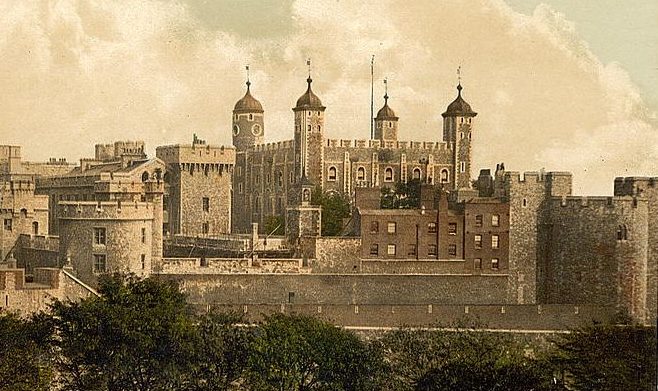
Gazing from the parlour window of the Lieutenant’s Lodging (also known as “The King’s House”) within the Tower of London, I took in the view of the chapel of St. Peter, the iconic White Tower—and the site of the executioner’s block. Knowing that this was the same view my ancestress Lucy St. John saw four hundred years ago sent a shiver of excitement through me. Lucy lived within the Tower for thirteen years, from 1617 to 1630, not as a prisoner, but as Mistress of the Tower.
 I discovered Lucy St. John’s legacy almost by accident while reading a fragment of a story in Lucy Hutchinson’s notebook transcription in Nottingham Castle. Her daughter’s memoirs give tantalizing glimpses of Lucy’s life, and further research on the role of the Lieutenant of the Tower—held by her husband, Sir Allen Apsley—unveiled even more details. The more I learned, the clearer it became that her story demanded a novel. Thus began my journey of piecing together her life, blending historical fact with narrative imagination.
Growing up in England in a family dedicated to genealogy, I was accustomed to sifting through the lives of ancestors, often spending more time on them than on present-day relatives. It was essential for my historical novels to be as accurate as possible, allowing readers to connect with the past as intimately as I do. I wanted them to feel as though centuries were no barrier to understanding Lucy and her world.
When I decided to make Lucy the protagonist of The Lady of the Tower, I reached out to Her Majesty’s Royal Palaces (HRP) with a hopeful request: Could I visit the Lieutenant’s Lodgings, her former residence? The staff graciously agreed and arranged for a Yeoman Warder as my guide.
 On a crisp winter’s morning, I arrived at the Tower before the crowds, walking along the old quay by Traitor’s Gate. Above the towering stone walls, the gabled roofs of the Lieutenant’s Lodging looked strangely domestic amidst the fortress. This surreal juxtaposition inspired the opening scene of my novel, where Lucy first encounters her new home and its looming history.
Inside, my guide and I quickly bonded over our shared love of history. Stepping into Lucy’s rooms, the overwhelming sense of connection with her was unlike anything I’d experienced. Standing in her stillroom and looking out from her parlour window, I felt as though I was truly retracing her steps. The emotions that arose from this experience informed many of the small, intimate details within The Lady of the Tower.
In one narrow corridor, just steps from the front hall, I encountered thick stone walls that signalled an older part of the Tower, the twelfth-century Bell Tower. This austere space, which once confined Thomas More, John Fisher, and even Princess Elizabeth, was just feet away from Lucy’s family quarters. The view through the narrow slit windows was the same as hers: the execution block. These haunting echoes of history stirred my imagination, adding a layer of melancholy that permeated my writing.
Lucy’s role as Mistress of the Tower included caring for prisoners. Known for her skills as a herbalist, she provided comfort to many of the captives. I found a delightful reference to her hen-house, which she lent to Sir Walter Raleigh for his alchemical experiments during his tim e in the Bloody Tower. This detail sent me on another research adventure, exploring herbal remedies and alchemy. In addition, Lucy’s niece Johanna compiled a book of remedies, now in the Wellcome Museum, which became a valuable resource for period-accurate recipes in my novel.
Raleigh, a gardener himself, likely shared plant knowledge with Lucy. I couldn’t resist weaving into the story their exchange of “Virginia Potatoes” and other medicinal herbs. These small interactions are where historical fiction shines, allowing for creative interpretation as long as it’s rooted in solid research.
Exploring the Tower’s grounds, I thought of Lucy’s garden, now covered by later constructions, though traces remain with a small area has been re-dedicated to her plants by the entrance to the Bloody Tower. I imagined her tending her medicinal herbs, a practice common for women of her rank and upbringing. Her responsibilities extended beyond her family to the Liberty of the Tower, a small city exempt from London’s jurisdiction. I envisioned her not only aiding the Tower’s aristocratic prisoners but also supporting the local residents, ministering to the community that her husband governed.
 One of the most emotional moments in my research was visiting St. Peter ad Vincula, where Lucy’s husband is buried. Standing beside the commemorative stone for Anne Boleyn and other souls lost to the Tower’s history, I felt my ancestors’ presence keenly. In the Yeoman’s private chapel, a votive candle burns for Sir Thomas More, a poignant detail that I knew I had to include in my book.

Since the release of The Lady of the Tower, it’s been gratifying to see readers connect with Lucy’s story. One of my proudest moments came when Her Majesty’s Royal Palaces requested to stock my book in the Tower’s gift shop. In a way, Lucy returned home, her story still alive within the walls that once sheltered her.
The Lady of the Tower is available on Amazon and Kindle Unlimited
Explore my Books: History’s Hidden Women

Falling in love should set you free…not send you to the Tower of London.

Amid the chaos of war, she challenges her family’s divided loyalties and love to survive.

The spymistress, the courtier, the rebel. Three women navigate love, ambition, and sacrifice.

If you knew the fate of the Princes in the Tower would you tell? Or forever keep the secret?

One woman’s quest for a truth that could change a nation: the discovery of the Missing Princes.

Please enjoy these free novelettes