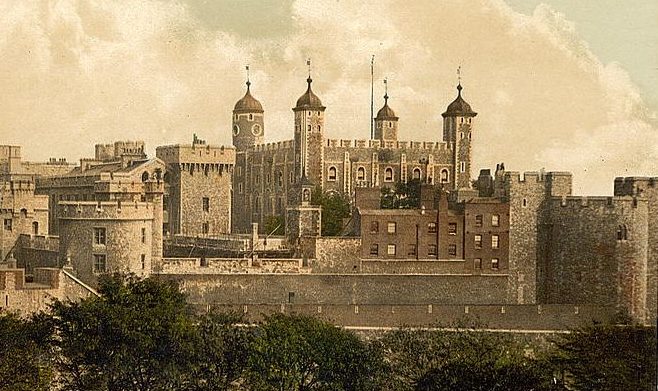
In 1674, workmen demolishing dilapidated wooden structures in the Tower of London made a shocking discovery. Two small skeletons were unearthed by a staircase at foot of the White Tower, reigniting the mystery of the missing Princes in the Tower—Edward V and Richard, Duke of York. Allegedly murdered by their uncle, Richard III, in 1483 to secure his claim to the throne, the princes’ fate had remained unsolved for nearly two centuries.
King Charles II opportunely seized on the discovery, using it to solidify his position in a time of political unrest and suspicion of Catholic plots. Declaring the bones to be those of the long-lost princes, Charles ordered Christopher Wren to design an urn for their reburial in Westminster Abbey, hoping to quell potential dissent and reinforce his own royal legitimacy. He also ordered sermons to be preached, mourning, and even a special production of Shakespeare’s Richard III to emphasise the significance of the find.
The discovery came at a delicate moment. Charles was secretly negotiating the Treaty of Dover with Catholic France, securing financial support in exchange for an eventual conversion to Catholicism. The secret deal added to the growing distrust within his Protestant nation. , his brother, the Duke of York, was also manoeuvring for power, bargaining with Europe’s leaders to arrange the marriage of his daughter, the Protestant Mary, to secure his family’s place on the throne.

As historical fiction inspired by facts, The King’s Intelligencer is set amid this political intrigue, and as with my other novels, is based on family history and documents. We have records that Sir Allen Apsley and his son, Peter Apsley, were on the payroll as spies and intelligencers during this period. We know that Allen’s cousin, Nan Wilmot, the Countess of Rochester, was directly involved with England’s secret agent network during the Civil War. And, as confidante and favourite to Lady Mary Stuart, heir to the throne, Allen’s daughter Franny was perfectly placed to gather intelligence about the royal family. When Franny discovers a dangerous piece of her own family history about the missing princes (hint, The Godmother’s Secret) she is drawn into a dangerous web of court politics. Her investigation is further complicated by her attraction to Nicholas Jameson, a secretive court artist, and the presence of a royal spy.
What began as a search for answers about the bones unravelled a much larger conspiracy, threatening not only the Stuart monarchy but the stability of England itself.
We don’t know the identity of the bones discovered in the Tower and buried in Westminster Abbey. Just as we don’t know what happened to the missing princes. Nor may we ever: there is still discussion, but no action on the bones in the urn being DNA tested. But maybe The King’s Intelligencer will bring us just a little bit closer to the truth, before the curtain closes on the mystery once more. The King’s Intelligencer is Available on Amazon and Kindle Unlimited.

A summary of the report by King Charles’s surgeon, written in 1677 is as follows:
Upon Friday the [17th] day of July. An. 1674 (take this Relation from a Gentleman, an eyewitness, and principally concerned in the whole scrutiny) – in the margin is printed John Knight Esq., Principal Chirurgeon to His Majesty King Charles II – in order to the rebuilding of the several Offices in the Tower, and to clear the White Tower from all contiguous Buildings, digging down the Stairs which led from the King’s Lodgings, to the Chappel in the said Tower, about ten foot in the ground, were found the Bones of two striplings in (as it seemed) a wooden Chest, which upon the survey were found proportionable to the ages of those two Brothers viz about thirteen and eleven years. The Skul of the one being entire, the other broken, as were indeed many of the other Bones, as also the Chest, by the violence of the Labourers, who not being sensible of what they had in hand, cast the rubbish and them away together, wherefore they were caused to sift the rubbish, and by that means preserved all the Bones. The Circumstances from the Story being considered, and the same often discoursed with the Right Honourable Sir Thomas Chichley Kt., Master of the Ordnance, by whose industry the new Buildings were then in carrying on, and by whom this matter was reported to the King: upon the presumptions that these were the Bones of the said Princes, His Majesty King Charles II, was graciously pleased to command that the said Bones should be put into a Marble Urn, and deposited among the Reliques of the Royal Family in the Chapel of King Henry the Seventh in Westminster Abbey.